After an arrest on suspicion of driving under the influence (DUI), the arresting officer takes you to the nearest station or hospital to administer a chemical test. If the results from the test indicate a blood alcohol concentration (BAC) of at least .08%, you will face criminal charges. Additionally, the officer will confiscate your physical license and communicate the arrest to the California Department of Motor Vehicles (DMV).
You will have ten days from the arrest date to request an administrative per se (APS) hearing. Failure to act will result in an automatic license suspension. Here is what you must know about the proceeding and how to win it.
A Quick Glance at APS Hearing
An APS proceeding is an administrative hearing conducted in the DMV’s safety offices to determine whether your driving privileges should be withdrawn following an arrest or a citation for the following:
- DUI with a BAC of at least .08%
- Refusal to submit to chemical testing after a drunk or drugged driving arrest
- Underage DUI with a BAC of at least 0.1%
You, the arrestee, are the person who requests the hearing ten days following the arrest. If you fail to request the hearing or do it after the set deadline, you relinquish the right to defend your driver’s permit against suspension, leading to an automatic license suspension after 30 days. The goal of the proceeding is to determine whether you should retain the license or lose it.
The Buildup to the APS Proceedings
When a traffic officer arrests you for DUI with a BAC of .08% or more, they will confiscate your driver’s permit unless you reside outside the state. The officer then issues you a suspension notice or DS-367, which acts as your temporary driver’s permit for thirty days. The notice also informs you that you are entitled to file for a DMV proceeding within ten days of the arrest or risk an automatic permit suspension or cancellation after one month.
It is advisable to call your attorney or the driver safety officer when you receive the notice to schedule a hearing before the deadline expires. If the timeline lapses without a request being submitted, the DMV initiates an automatic administrative license suspension.
Scheduling a DMV Proceeding
The first step you should take to schedule an APS hearing is to call the local driver safety office (DSO). The office is different from the DMV, which issues driver’s permits and car registrations. Contact the driver safety office within 10 days after arrest to retain the right to challenge the driving privileges suspension.
Alternatively, you can consult with a local seasoned DUI attorney to request the hearing on your behalf, even though legal representation is not necessary in this hearing. An experienced attorney will schedule the hearing early and help you develop defense strategies for the hearing to protect your license.
Once you or your attorney schedules the proceeding, the DMV issues an interim driver's permit valid for a month. If the proceeding does not HAPPEN within this period, the DMV will stay the suspension, allowing you to continue using the temporary permit until the APS hearing occurs or the DMV rules on the suspension.
Expectations After the Police Confiscate Your Driver’s License (DL)
Typically, officers confiscate your physical DL after you are arrested. Once the permit is in the arresting officer's hands, they have 5 business days from the arrest date to submit a police report, along with your DL, to the DMV headquarters in Sacramento.
Upon receiving the DL, the DMV has two options. To destroy the physical DL or update your driving history to reflect a pending APS hearing.
The DMV will then transfer the report and other supporting documents to your local DSO where the arrest occurred. The DSO then assigns your case to a DMV hearing officer who conducts an initial study of the case to make recommendations. The DMV personnel can decide that the arresting officer lacked sufficient probable cause for the stop and subsequent arrest and recommend setting aside the administrative proceeding. When this happens, the DMV cancels the scheduled APS and restores your DL.
Alternatively, the hearing officer can find the evidence provided insufficient to support the accusation and return the file to the relevant officer for further investigation and additional proof.
Lastly, the officer can conclude, based on the report and evidence, that the arresting officer made the right call, and you, the accused, should face an administrative proceeding for a verdict regarding your license.
The DMV Proceeding
A DMV officer presides over all APS proceedings. The officer is an employee of the DMV, not a judge or a lawyer.
In the APS hearing, the DMV bears the burden of proof and must prove that the arresting officer had reasonable cause to believe you were drinking and driving and that your BAC at the time of the arrest was .08% or above. The hearing officer will then give you the chance to contest the assertions or poke holes in the DMV’s evidence.
After reviewing the evidence, the hearing officer can find by a preponderance of the evidence that you drove with a BAC of at least .08%. This is a low evidentiary standard because the DMV only needs to demonstrate that it is more likely than not that you were behind the wheel with a BAC of at least .08%. The low evidentiary standard applies to these cases because they are civil proceedings and separate from the criminal court case. So, you could still lose your DL to an administrative suspension and still win the criminal court case because, in a criminal case, the evidentiary standard is higher. The prosecutor in the DUI case must prove beyond a reasonable doubt that you drove with a BAC of at least .08%.
-
The Evidence the Presiding Officer Considers to Determine the APS Hearing
The proof the presiding officer considers includes the police report and the defendant's breath, blood, or urine test. You can counter the police report and test results by introducing additional evidence, such as eyewitness testimony, dashboard camera video footage, and GPS data. You should use this information to challenge the DMV’s arguments.
-
Determining the APS Hearing
The DMV officer presents evidence against you and listens to your side of the story to give a verdict. The officer will uphold the DL suspension if the DMV evidence shows it is more likely than not that you were arrested at a sobriety checkpoint. Your arrest was legal, and that during the arrest, your blood alcohol levels were at least .08%.
However, the APS hearing verdict does not affect your criminal case, as these are two separate proceedings.
You can increase the chances of a fair outcome in the APS hearing by partnering with a seasoned DUI attorney. An experienced attorney has successfully handled cases like yours and understands the challenges you might encounter and how to resolve them in your favor. Also, the right attorney understands the laws that apply to DMV proceedings and will use this to your advantage.
Testimony from accident reconstruction experts and forensic alcohol professionals can strengthen your defense. Your attorney knows the best experts in the locality and can use their testimony to protect your driving privileges.
-
APS Proceedings vs. a Criminal Trial
The APS hearing and the criminal court case must follow the procedures provided by law, but this does not mean the two hearings are the same. In a court case, the prosecutor files charges, and as the defendant, you have a right to legal counsel, and if you cannot afford one, the court will appoint a public defender. A judge or jury presides over the criminal case. The prosecutor, judge, and defense attorneys are law school graduates and recognized by the bar. The prosecutor bears the burden of proof and must demonstrate beyond a reasonable doubt that you operated a car with a BAC of at least .08%. Your defense attorney is also given the chance to defend against the charges. Once all parties have presented their cases, the judge or jury deliberates and issues a verdict.
The criminal penalties you will face if the criminal court finds you guilty include:
- Hefty fines
- Installation of an ignition interlock device
- Jail incarceration
- DL suspension
- Probation
- Mandatory enrollment in a DUI School
On the other hand, an APS proceeding is presided over by a hearing officer who is an employee of the DMV and has no law degree nor is recognized by the bar. You, the defendant, have no right to legal counsel. You may hire a private attorney if you can afford one, but it is not mandatory. Even if you can represent yourself in the DMV proceeding, you are encouraged not to. Instead, hire an attorney with knowledge of DUI statutes and DMV administrative procedures to protect your rights.
Additionally, in the APS hearing, the officer presiding over the case is also the party presenting evidence on behalf of the DMV and ultimately deciding on the most appropriate administrative punishment. The punishment you can face for an unfavorable outcome in an APS proceeding is license suspension and installation of an IID. The suspension duration depends on the prior DUI violations. If it is your first violation, the DMV will suspend your DL for four months, while a second offense attracts no more than twelve months of DL suspension.
The APS proceeding is informal, and the evidentiary standard is relaxed, as it is a civil matter. The police report and hearsay evidence can also be used to decide the case.
Winning your APS Hearing
You need a DUI defense attorney to convince the DMV officer to reverse the license withdrawal. The arguments you should make include:
The Police Officer’s Paperwork had Fatal Errors
The DMV relies on the police report and hearsay as its primary evidence in the case because the rules here are relaxed. Therefore, your attorney can question the reliability of the results by highlighting errors in the BAC results recorded, the date indicated in the forms, and the lack of a signature. Any errors in the paperwork can be used to question the credibility of the police report, leading to the suspension being withdrawn.
The Arrest was Unlawful
Police officers need probable cause to stop a vehicle or make an arrest. Probable cause includes speeding, a broken tailgate, and/or violation of traffic rules. If the arrest was illegal or was made for illegal reasons, such as racial profiling, all the evidence gathered against you is inadmissible in the hearing. The DMV officer will reverse the suspension if the arrest is unlawful.
The BAC Test Results Indicate a False High
DUI laws outline procedures for storing and maintaining testing devices. Breathalyzers must be properly calibrated, while the officer must observe you for fifteen minutes before conducting a test. In chemical testing, the blood sample must be split, with one portion stored properly for future testing. If these rules were not followed, the DMV cannot rely on the test results as evidence. They will dismiss the case and restore your license.
Another explanation for a falsely high BAC reading is physiological factors. Your attorney states that the results were falsely high because you were on a protein- or carbohydrate-rich diet. Also, they can argue that you suffer from acid reflux, and the condition led to false BAC results.
Appealing the DMV Decision
Even with a strong defense, sometimes the verdict of the APS hearing might be against you. If you are unsatisfied with the decision, you have fifteen days from the date of the suspension order to file for an administrative review of the case. All administrative review applications are addressed by the legal department, which examines the evidence presented in the hearing and upholds or reverses the DL suspension.
Additionally, you can submit a writ of mandate to the California Superior Court. A writ is necessary if you are convinced that by issuing the order to suspend your license, the DMV officer violated your rights.
Find a Competent Per Se DUI Attorney Near Me
If you have been apprehended for a DUI offense and there is a pending administrative per se hearing, you should consult an experienced DUI attorney to preserve your driving privileges. You need an attorney immediately because you only have ten days to request a DMV hearing, or else your permit will be suspended or revoked.
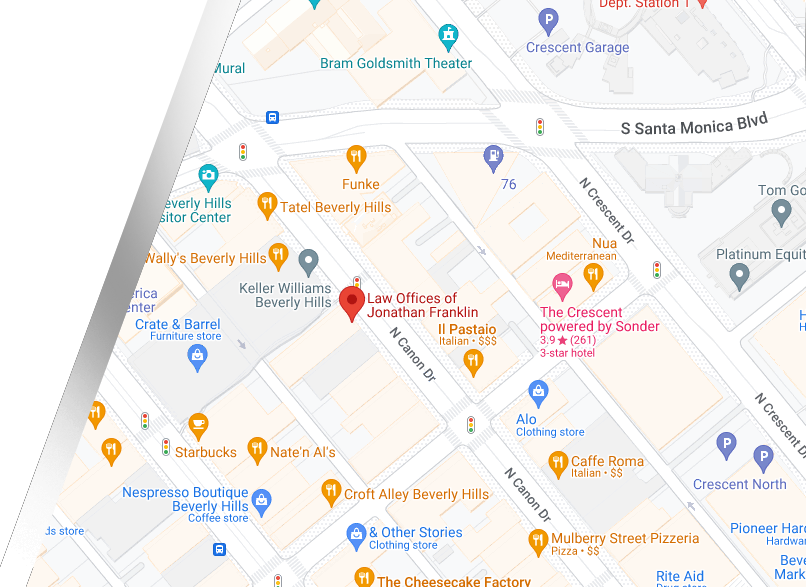
At the Law Offices of Jonathan Franklin, we can represent you in the DMV proceeding and the court case to achieve a favorable outcome. Call us today at 310-273-9600 for more information on APS hearings and to arrange a no-obligation consultation in Los Angeles.